30% of banking revenue disappears into process waste every year. Not fraud. Not credit loss. Waste: the kind that hides inside approval chains, handoff queues, and software switching that your team does before lunch on any given Tuesday.
Your operations team may have sat through a Lean Six Sigma certification. They learned TIMWOOD. They nodded along to the car assembly line analogies. Then they returned to a 139-step loan origination process and saw zero connection between a Toyota factory floor and a retail credit queue in Riyadh or Manila.
That's the gap nobody closes in the certification room. This post closes it.
Why TIMWOOD Was Built for Factories—And Why That's a Problem
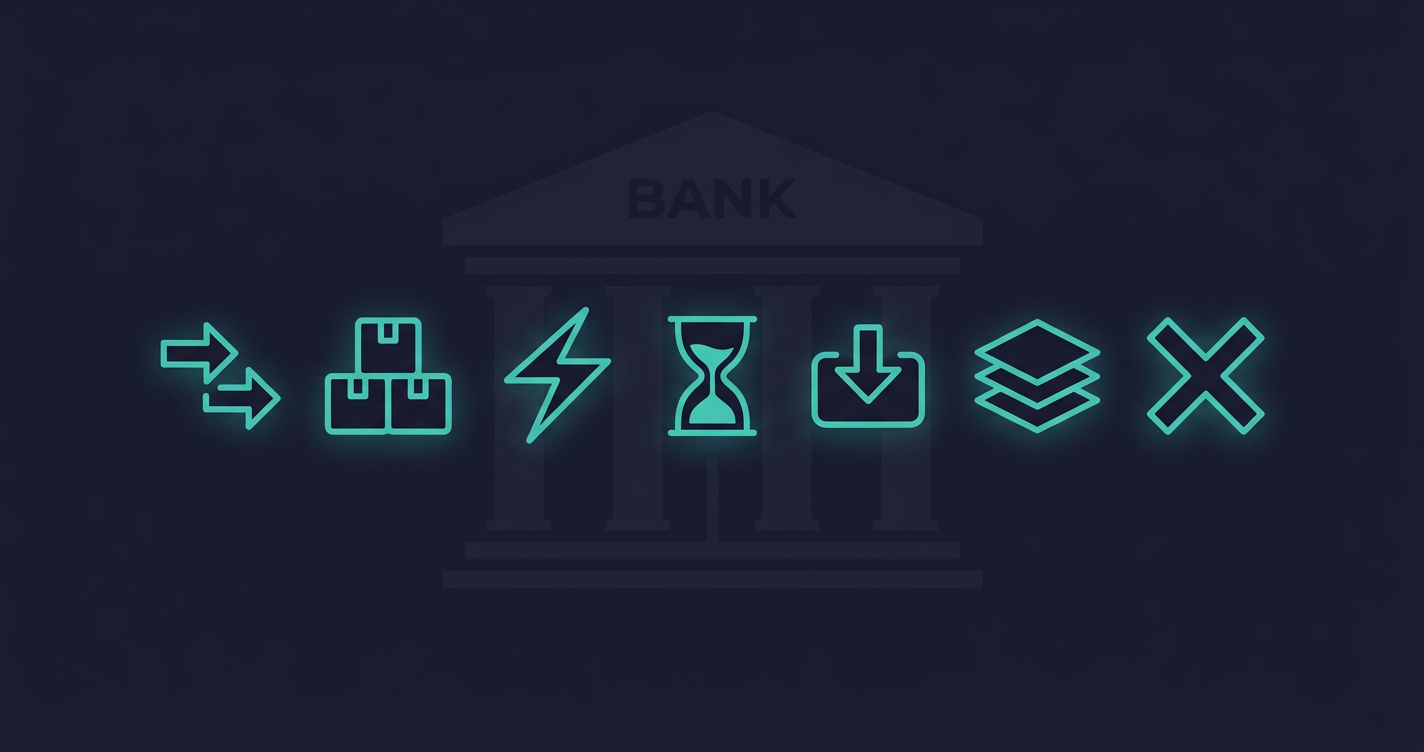
TIMWOOD is the mnemonic for the 7 wastes of Lean manufacturing: Transportation, Inventory, Motion, Waiting, Overproduction, Overprocessing, Defects. It was codified to eliminate physical movement, physical stock, and physical rework from assembly lines.
Banking has no physical stock. It has information stock. It has approval chains. It has data that travels across seven desks before anyone acts on it.
The translation isn't automatic. Below is the translation your team needs, complete with the signals that tell you the waste is present and the three-question audit you can run on any process step today.
The 3-Question Waste Audit
Apply these three questions to every process step as you work through the waste types below.
- Does this step produce output the next step uses? If the answer is "sometimes" or "it depends," you have a waste candidate.
- If this step disappeared, would the customer notice? Not the compliance team. The customer.
- Does the approval level match the risk? A $500 expense claim requires three manager sign-offs at dozens of banks across APAC. That's not governance. That's habit.
Transportation: Information Moving Between 7 Desks
Standard definition: Unnecessary movement of materials or information from one location to another without adding value.
In a factory: A component travels 40 meters to a workstation that could have been positioned 4 meters away.
In banking: A retail loan application moves from branch officer to operations team to credit analyst to risk to compliance to approvals to documentation. Each step is a manual email forward, a system re-entry, or a PDF attachment on a shared drive. The information doesn't change in transit. It just moves.
You have this waste if you see:
- Staff manually re-entering data that already exists in another system
- "FYI" email chains where no one takes action
- Documents printed, signed, scanned, and uploaded, when a digital signature was available the entire time
ESSAM case connection: In ESSAM's process mapping work with APAC banks, transportation waste consistently appears at handoff points between core banking systems and workflow tools. One retail bank we worked with had 11 distinct handoff points in its personal loan process. Nine of them involved manual data re-entry. When handoffs require a human intermediary to copy-paste or reformat data, you've built transportation waste into the architecture itself. The waste isn't in the system. It's in the gap between systems.
Inventory: 200 Loan Applications in a Queue
Standard definition: Excess product or information waiting to be processed.
In a factory: 400 units sitting in a buffer between two workstations because workstation B is slower than workstation A.
In banking: A credit operations team with 200 loan applications in queue at the start of each week. The applications arrived. The team hasn't touched them. They're accumulating, not because the bank is busy, but because the intake rate exceeds the processing rate and no one has surfaced the bottleneck.
You have this waste if you see:
- Queue backlogs that persist week over week without growing shorter
- KYC document requests that pile up faster than analysts can review them
- Account opening requests aged beyond your stated SLA with no escalation trigger
ESSAM case connection: Inventory waste is the waste that shows up in customer satisfaction surveys before it shows up in internal dashboards. By the time leadership sees it in a monthly report, the customer has already called three times. In one process mapping engagement, we found a bank where 340 KYC renewal requests sat untouched for 22 days. Not because analysts were unavailable. No queue monitoring existed. The backlog was invisible until customers escalated.
For an in-depth look at how cycle time connects to inventory buildup, see our post on DMAIC in banking.
Motion: Navigating 4 Systems Before 10am
Standard definition: Unnecessary movement of people or repeated switching between tools and interfaces.
In a factory: A technician walking to a tool cabinet 20 times per shift because tools aren't stored at the point of use.
In banking: A relationship manager who opens the CRM, then the core banking platform, then the credit system, then a spreadsheet, then back to the CRM. All before completing a single customer task. Each context switch costs 2–5 minutes in cognitive reorientation. At 8 switches per day across a 200-person operations team, that's 320–800 hours of lost productive capacity every week. It shows up nowhere in your P&L. It shows up in processing times and error rates.
You have this waste if you see:
- Staff maintaining personal "shadow systems" (spreadsheets, personal notebooks) to track information that should live in one place
- System logins that expire mid-task, forcing re-authentication
- Process documentation stored in three different folders by three different teams
ESSAM case connection: Motion waste is the waste that Black Belt practitioners spend 80% of their time documenting rather than eliminating. The observation and mapping phase is necessary. The intervention needs to happen faster than most traditional improvement cycles allow.
Waiting: Where 80% of Your Cycle Time Lives
Standard definition: Time spent idle while waiting for information, approval, or the next step in a process.
In a factory: A partially assembled unit sitting between two workstations because the next station isn't ready.
In banking: Waiting is the dominant waste. In one Kuwait-based bank, ESSAM's process analysis revealed that 80% of loan origination cycle time was pure waiting. Approvals queued. Customer documents outstanding. Credit committee schedules misaligned with application volumes.
The bank's full loan origination process ran 139 days. After eliminating waiting waste through redesigned approval triggers and automated document request workflows, the cycle dropped to 57 days, a 59% reduction. That's not a marginal process improvement. That's a competitive repositioning. A bank that approves loans in 57 days is a different product than a bank that takes 139 days.
You have this waste if you see:
- Approval queues that require manual chasing
- Customer-facing SLAs built around internal committee schedules rather than customer needs
- Process steps that are "on hold pending" more often than they are active
ESSAM case connection: Waiting waste responds faster than any other waste category to clear escalation triggers and automated follow-up logic. The Kuwait bank example wasn't a technology overhaul. It was a systematic answer to the question: "What happens when nothing happens for 48 hours?"
Overproduction: Reports Nobody Reads
Standard definition: Producing more than what is needed, faster than it is needed.
In a factory: Manufacturing 1,000 units when the order was for 600.
In banking: A weekly risk report that took 14 analyst hours to produce and was actively read by two people. A branch performance dashboard emailed to 47 recipients; in one bank we audited, click tracking showed 38 recipients had never opened a single edition in six months. A compliance checklist with 90 line items when 30 were relevant to the product under review. The other 60 existed because nobody had updated the template in four years.
Overproduction waste is the hardest to see because it looks like diligence. The team that produces it is working hard. The output exists. No one has paused to ask whether the output is used.
You have this waste if you see:
- Reports distributed to large distribution lists with no read-tracking
- Analytical outputs that inform no decision and trigger no action
- Compliance documentation prepared "just in case" at a level of detail that exceeds the regulatory requirement
ESSAM case connection: In banking operations, overproduction waste often signals a deeper problem: teams lack clarity on which decisions require which data. Eliminating overproduction means defining decision rights first, then working backward to the minimum viable information package.
For a broader look at how common this pattern is across banking operations, see our analysis of 500 business processes.
Overprocessing: 8 Sign-Offs on a $500 Expense
Standard definition: Doing more work than the output requires by adding steps, approvals, or checks that don't change the outcome.
In a factory: A component polished to a tolerance 10 times tighter than engineering requires.
In banking: A $500 staff expense claim requiring sign-off from a direct manager, department head, finance officer, and regional controller. The risk associated with the claim is not $500. It's whether the expense was legitimate. That determination requires one qualified reviewer, not four sequential ones.
Overprocessing is endemic in risk-averse cultures. Every additional approval feels protective. Collectively, they create a process where the cost of the approval exceeds the value being protected.
You have this waste if you see:
- Approval chains where each approver reviews the same information as the previous one without adding a distinct judgment
- Document reviews that require full legal sign-off for standard-form contracts
- Customer onboarding steps that repeat verification the bank already completed at account opening
The 3-question audit applied here: Does the fourth sign-off produce output the next step uses? Would the customer notice if it disappeared? Does the approval level match the risk? For a $500 expense: no, no, and no.
ESSAM case connection: The Kuwait bank's 59% cycle time reduction involved both waiting waste and overprocessing waste. Several approval nodes in the loan origination process were dual or triple approvals on identical information packets. Removing redundant approvals (not cutting oversight) was a significant contributor to the 82-day reduction.
Defects: Loan Applications Rejected and Resubmitted
Standard definition: Errors that require rework, correction, or reprocessing.
In a factory: A component that fails quality inspection and must be remachined or scrapped.
In banking: A loan application rejected at underwriting because a document uploaded at the branch was the wrong version. A payslip from 14 months ago, when the requirement was a three-month current copy. The application re-enters the queue. The customer resubmits. The branch officer reprocesses. The underwriter reviews again. One defect generates four to six additional process touches, adds 7–12 days to cycle time, and increases the probability the customer walks away before approval.
Defects in banking are expensive not just because of rework time. They're expensive because they occur at the point in the process farthest from the cause. By the time underwriting rejects an application for a missing document, the branch interaction that caused the omission was two weeks and four hands ago.
You have this waste if you see:
- Rejection rates at underwriting or compliance review above 15%
- Frequent customer callbacks for information that should have been collected at intake
- Error rates that increase under volume, signaling that the process depends on individual vigilance rather than system design
ESSAM case connection: Defect waste requires root-cause discipline. The $3 trillion global cost of operational inefficiency in banking is disproportionately driven by defects and rework. Not slow processes, but processes that restart because they weren't right the first time. The 70% of improvement initiatives that fail past year one often fail because they address speed without addressing the upstream conditions that generate defects.
Why These 7 Wastes Stay as Slides
Here's the real problem with TIMWOOD in banking: certification programs teach the categories in isolation. Practitioners return to their institutions, map one or two processes, and find waste. But they have no mechanism to quantify it, prioritize it, or connect it to cycle time and revenue impact in a way that leadership acts on.
The 80% of Black Belt time spent on documentation isn't wasted effort. It's misallocated effort. When data collection, process mapping, and waste quantification happen manually, the intervention window closes before the analysis is complete.
ESSAM was built to compress that cycle. The E-S-S-A-M framework—Examine, Structure, Solve, Act, Measure—applies the same seven waste categories but operationalizes them through AI-assisted process mapping that surfaces bottlenecks in days rather than weeks.
The Kuwait bank result (139→57 days, 59% reduction) wasn't exceptional because of a novel insight. It was exceptional because the waiting and overprocessing waste was identified and acted on inside a single quarter. The insight itself (approvals were queued and approval chains were redundant) was visible in any honest process map. The difference was the speed from map to action.
What a Waste Audit Looks Like in Practice
If you want to run a lightweight waste audit on your highest-volume process today, work through these steps:
Step 1: Pick one process (loan origination, account opening, or expense approval) and list every step from trigger to completion.
Step 2: Apply the three questions to each step: Does it produce output the next step uses? Would the customer notice if it disappeared? Does the approval level match the risk?
Step 3: Tag each step with a waste category (Transportation, Inventory, Motion, Waiting, Overproduction, Overprocessing, Defects) or mark it as value-adding.
Step 4: Count the ratio of value-adding steps to waste steps. In our analysis of banking processes, fewer than 30% of steps in a typical retail loan origination workflow are value-adding. The rest are waste of one type or another.
Step 5: Prioritize by impact. Waiting and Defects almost always yield the largest cycle time reduction when eliminated. Start there.
This audit won't give you a complete picture. But it will show you, in the next two hours, where your process is losing time and money. It will also give you a language to bring to leadership that connects operational observations to financial outcomes.
For a deeper look at how ESSAM supports structured process improvement in banking, see how it works.
Frequently Asked Questions
Q: Are the 7 wastes of Lean applicable to banking the same way they apply to manufacturing?
A: The categories are the same; the translation is different. In manufacturing, Transportation means physical movement. In banking, it means information movement: data re-entered, documents forwarded, files reformatted between systems. Each waste type requires a banking-specific lens to be actionable. The TIMWOOD framework is a starting structure, not a finished answer.
Q: What's the most common waste type in banking operations?
A: Waiting consistently accounts for the largest share of cycle time in banking processes. In retail lending, waiting for approvals, waiting for customer documents, and waiting for committee schedules can represent 70–85% of total processing time. The Kuwait bank case (cycle time from 139 to 57 days) was primarily a waiting and overprocessing elimination exercise.
Q: How do I convince leadership that waste reduction is worth investing in?
A: Translate waste into time and revenue. A loan origination process that takes 139 days versus 57 days isn't just an operational metric. It's a product differentiation metric and a customer retention metric. Calculate the annual revenue impact of cycle time reduction at your current loan volume. That's the number that moves leadership conversations.
Q: Can small banks or credit unions use this framework, or is it only for large institutions?
A: The framework scales by process complexity, not institution size. A 10-person credit union running 50 loan applications per month has the same waste types as a 10,000-person bank. The absolute time savings are smaller, but the proportional impact on customer experience and staff capacity is often higher because there's less redundant capacity to absorb waste.
Q: How long does a proper waste audit take?
A: A manual waste audit on a single process, from trigger to resolution, typically takes four to six weeks for a trained team. Most of that time goes to data collection and process mapping. With AI-assisted process discovery, the same audit can run in days. The goal isn't speed for its own sake. It's getting to the intervention before organizational attention moves elsewhere.
The Translation Was Always the Problem
Your team learned TIMWOOD. The framework is sound. The gap was never the theory. It was connecting a car assembly analogy to a 139-step loan origination process in a way that produced a decision on Monday morning.
The seven wastes exist in your processes right now. Waiting dominates cycle time. Overprocessing multiplies approval touches on low-risk decisions. Defects send applications back into queues that were already too long.
The banks that close that gap, between training room and operations floor, between waste identified and waste removed, are the ones that turn a 139-day process into a 57-day one. That's not a marginal improvement. That's a different bank.
If you want to map where these wastes live in your highest-volume process, talk to the ESSAM team.